THE PROJECT
Subaru dealerships needed to engage customers during the critical "browsing" phase before connecting with sales staff. I led visual design and art direction for an interactive touchscreen platform that transformed showrooms into self-service digital experiences—allowing customers to explore vehicles, compare features, and configure options at their own pace.
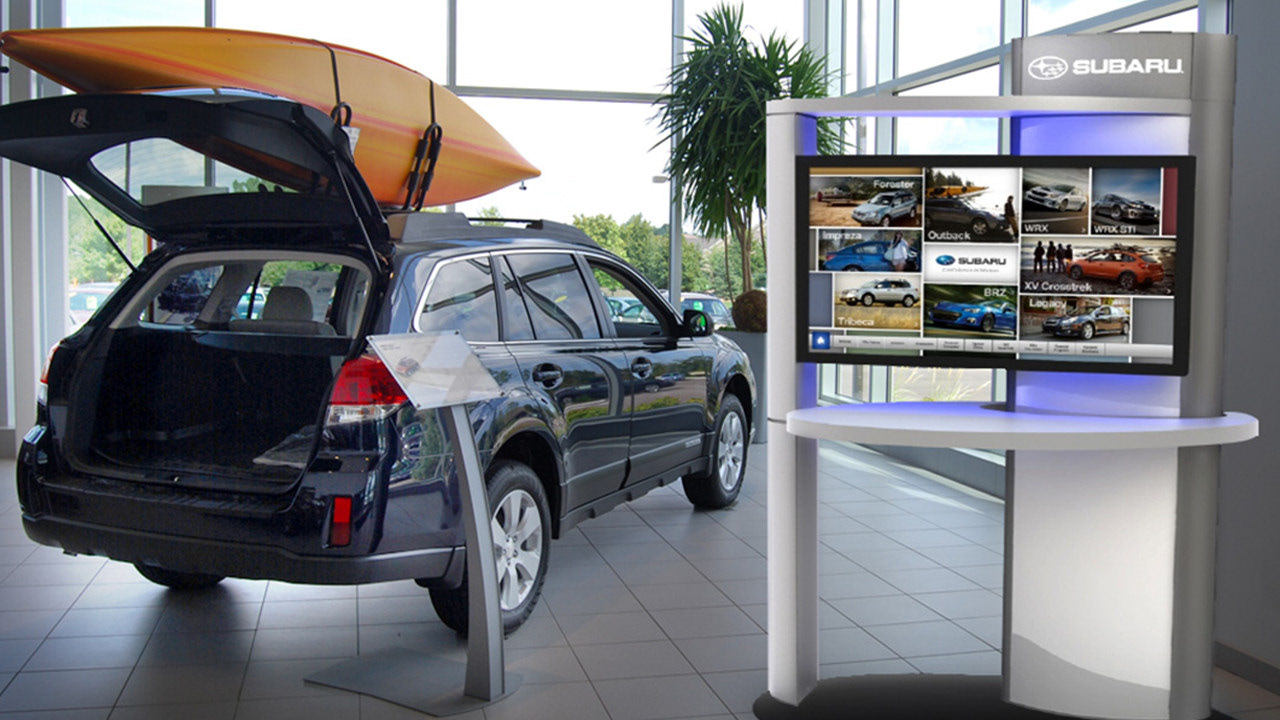
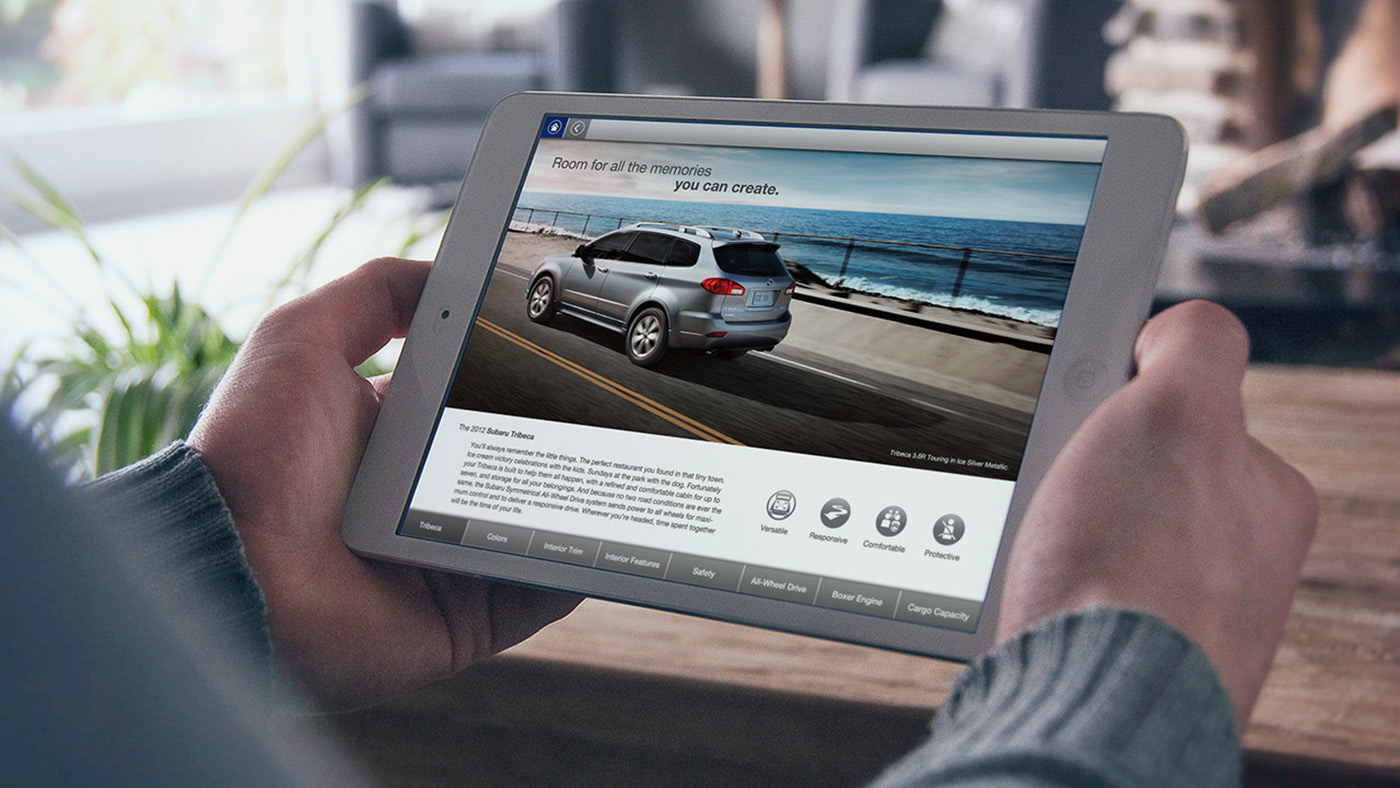
The system deployed across two formats: large-format touchscreen kiosks (32-42") for self-service browsing and companion tablets for sales-assisted consultations.
Role: Senior Visual Designer & Art Director
Employer: DCI Marketing
Deployed: 1,200+ Subaru dealerships nationwide
Legacy: Updated versions still in use today
Employer: DCI Marketing
Deployed: 1,200+ Subaru dealerships nationwide
Legacy: Updated versions still in use today

THE CHALLENGE
Designing for a unique physical environment meant addressing:
Dealership context: Bright lighting, ambient noise, standing users often in groups
No learning curve: Interface had to be immediately intuitive for users ranging from tech-savvy millennials to older buyers unfamiliar with touchscreens
Varying intent: Some users had 30 seconds, others had 30 minutes
Scale: Seamless content updates across 1,200+ locations as new models launched
No learning curve: Interface had to be immediately intuitive for users ranging from tech-savvy millennials to older buyers unfamiliar with touchscreens
Varying intent: Some users had 30 seconds, others had 30 minutes
Scale: Seamless content updates across 1,200+ locations as new models launched

KEY DESIGN DECISIONS
1. Visual-First Navigation
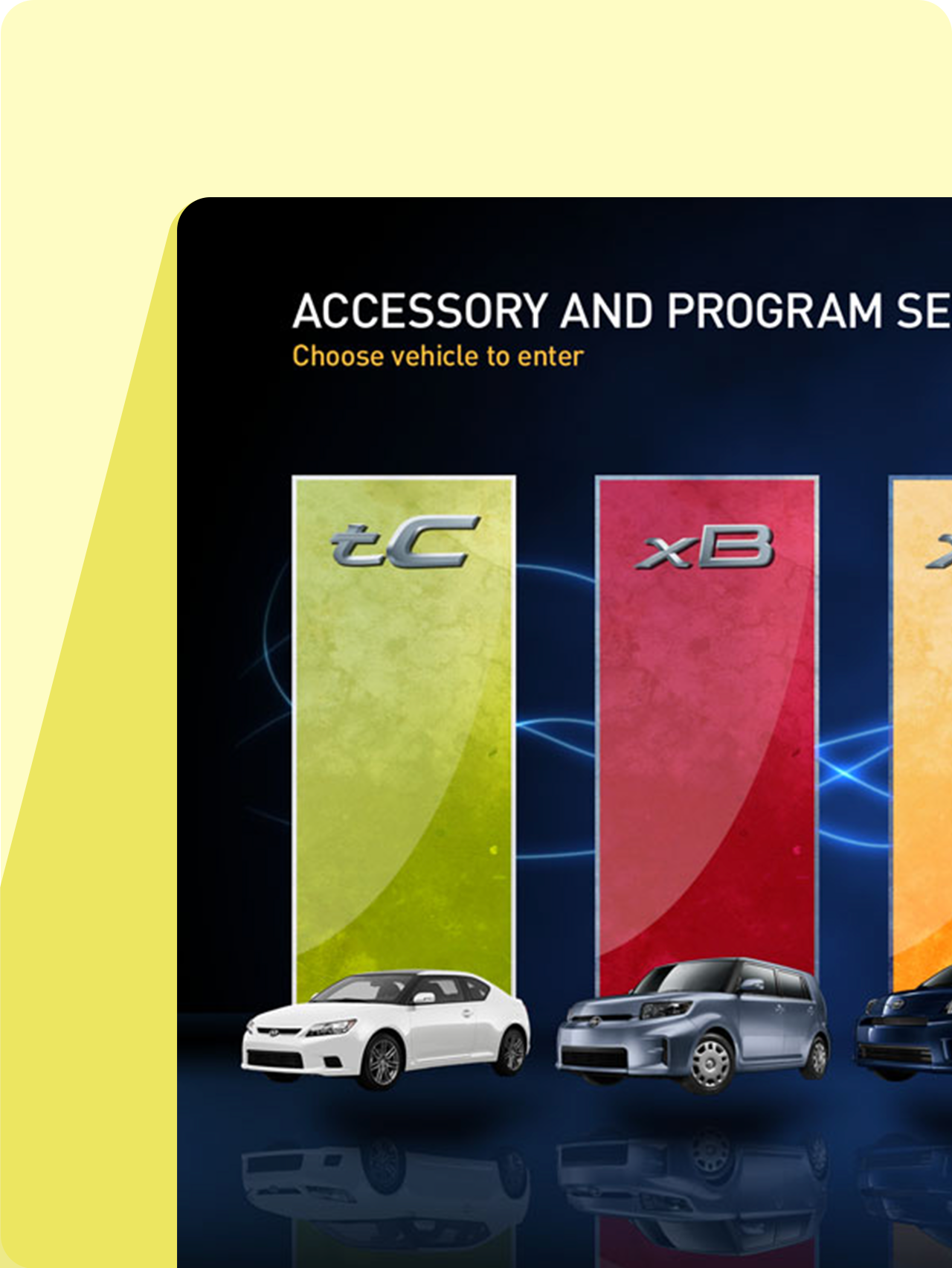
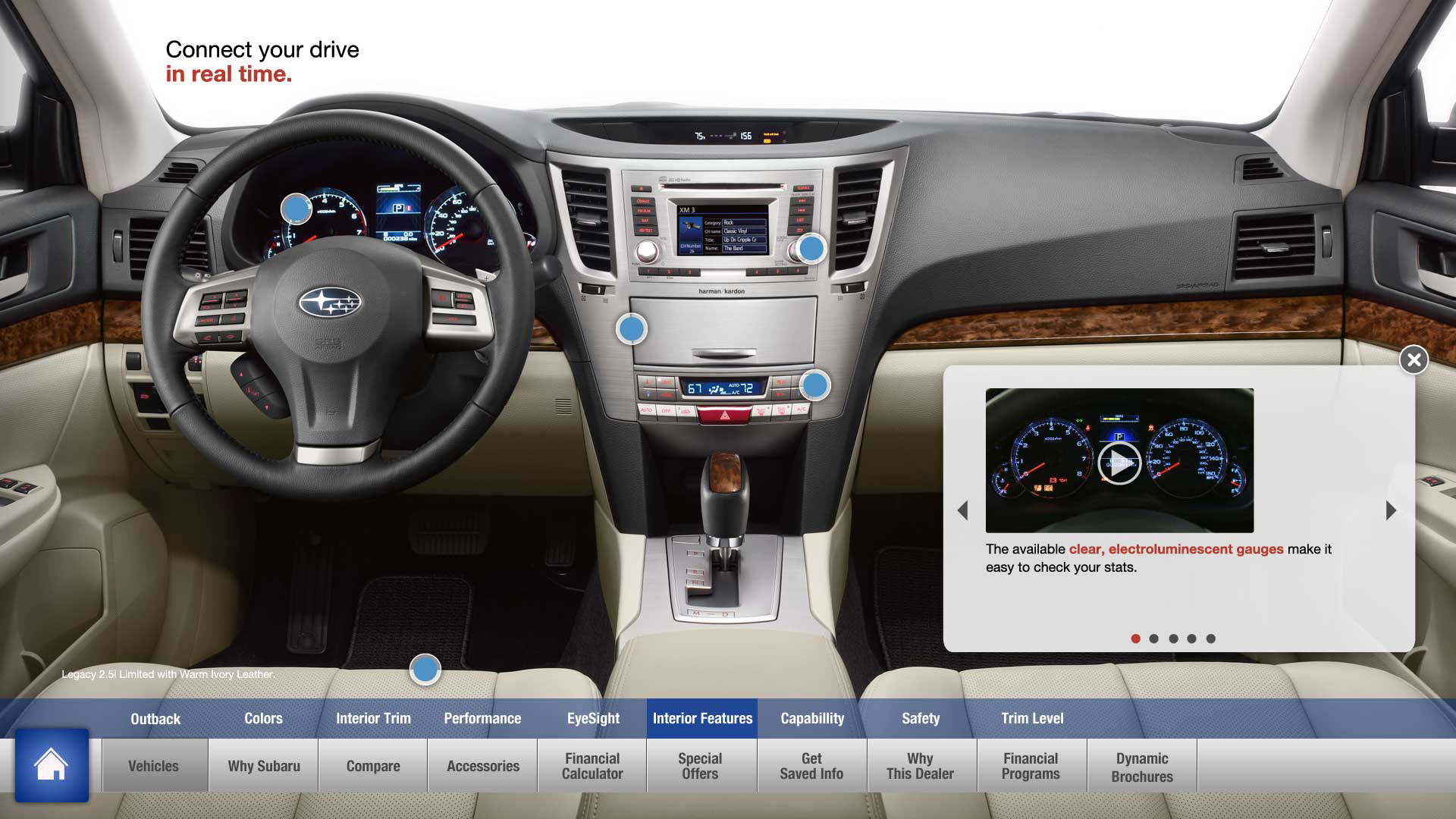
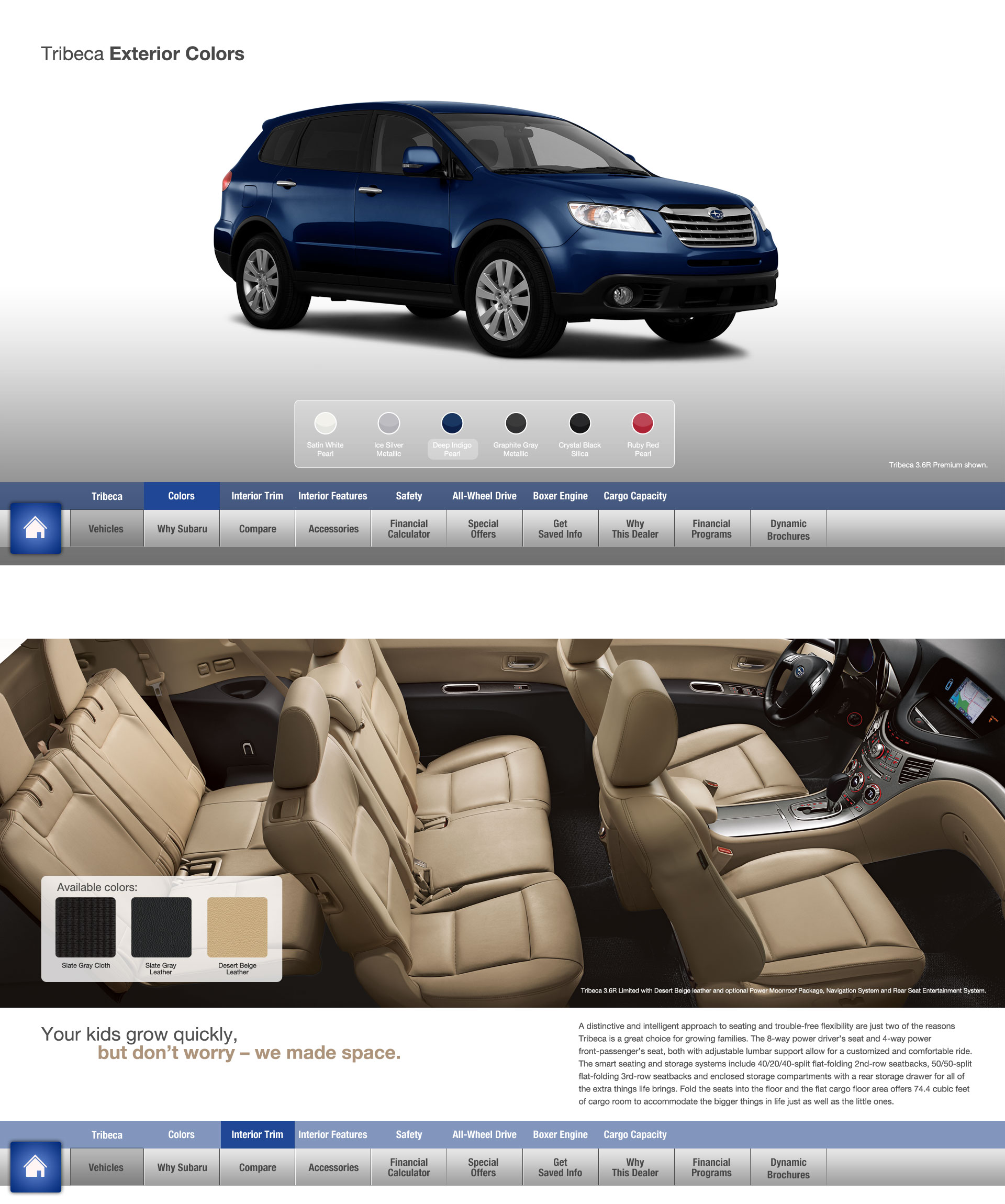
For standing users, often browsing with family, I designed completely visual navigation—large vehicle imagery as primary interface, not text menus. Touch targets were 80x80px (larger than mobile standard) to accommodate groups crowding around screens.
Why it worked: Users navigated by recognition, not recall. Seeing the Outback image vs. reading "Outback" created faster comprehension.
2. Layered Information Architecture
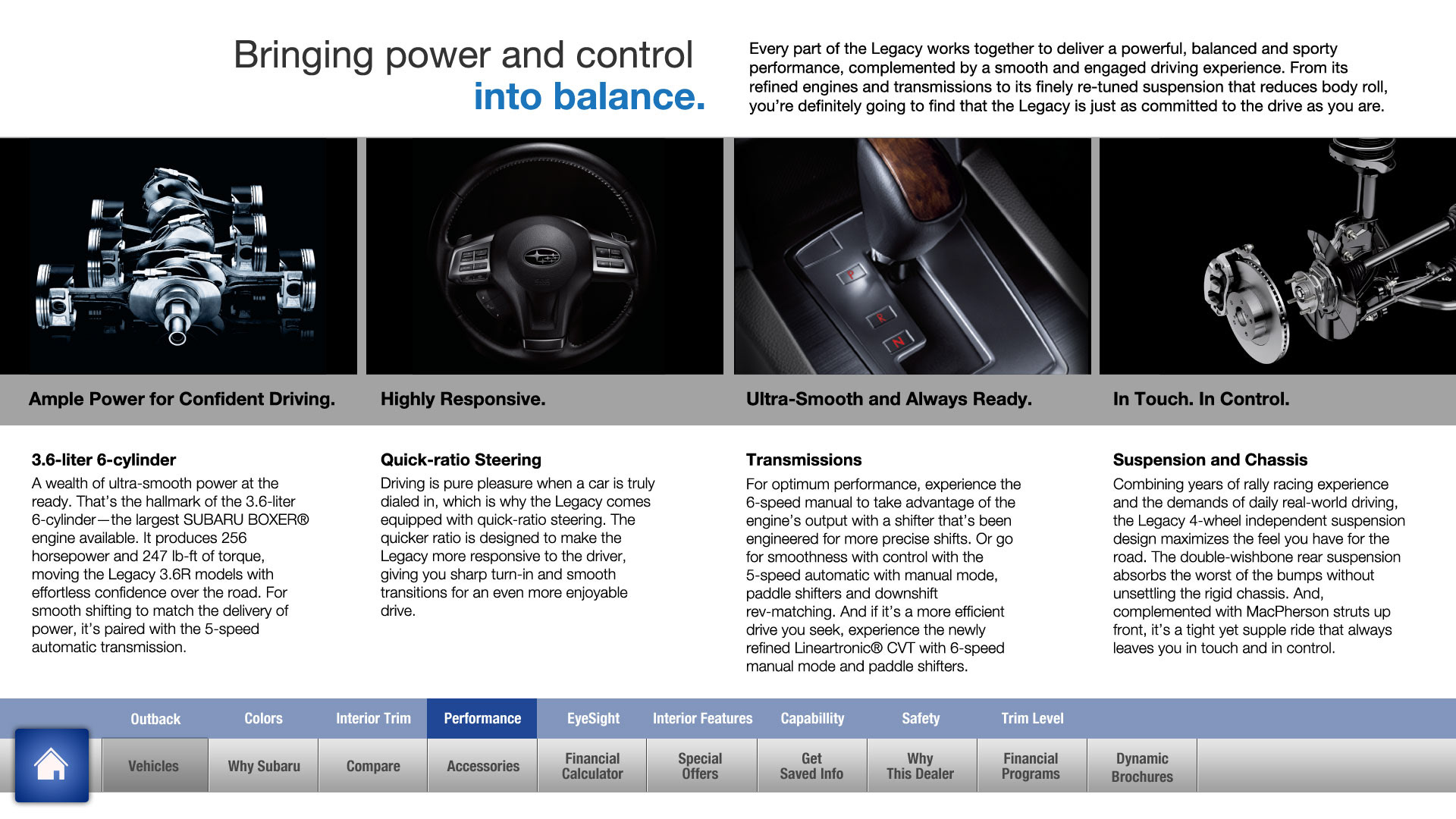
Created progressive disclosure serving different needs:
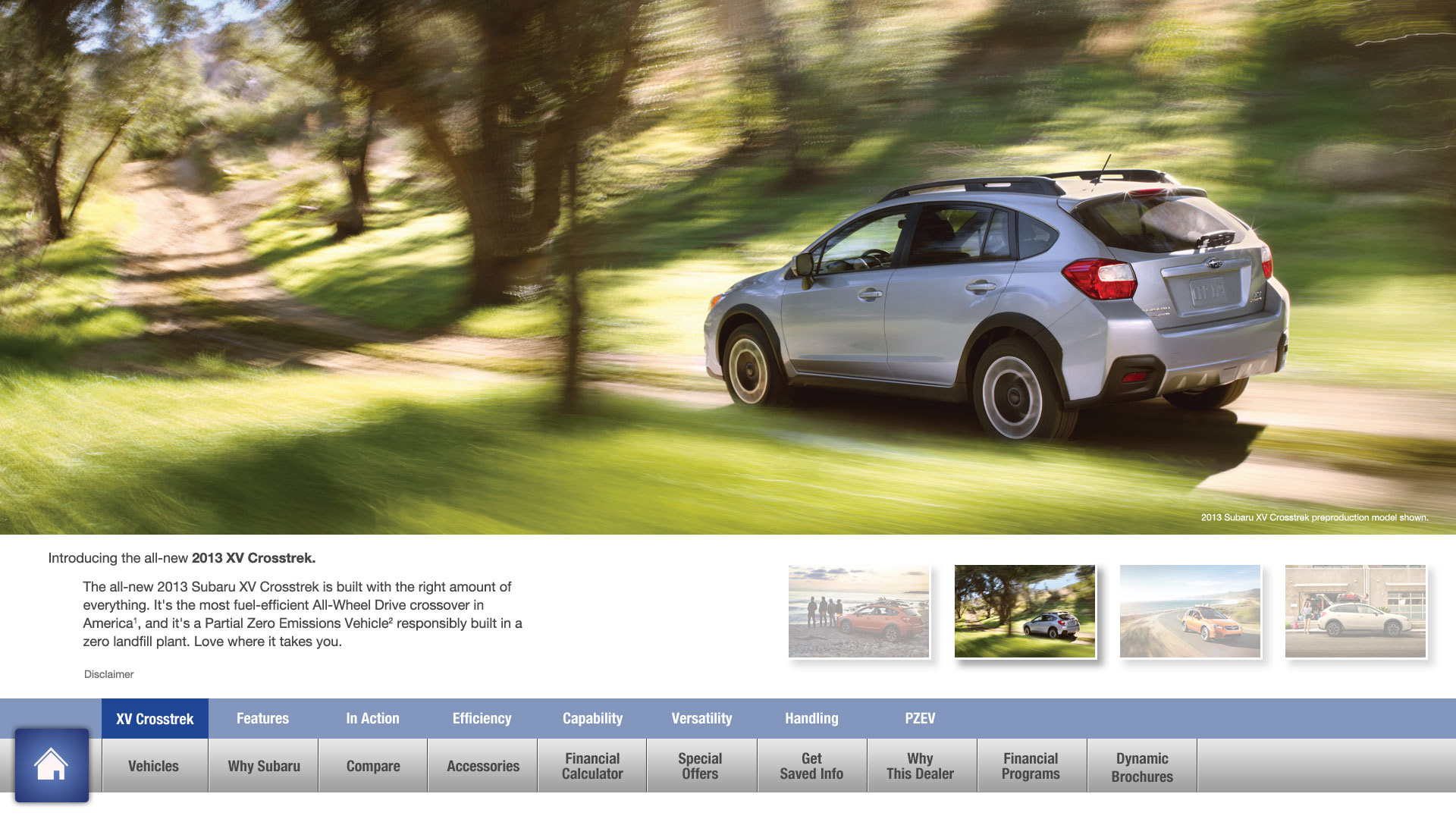
• Quick browse (30 sec): Vehicle lineup, key differentiators, pricing
• Feature exploration (5 min): 360° views, video demos, interactive hotspots
• Deep dive (15+ min): Specs comparison, configurator, inventory search
• Feature exploration (5 min): 360° views, video demos, interactive hotspots
• Deep dive (15+ min): Specs comparison, configurator, inventory search
This architecture enabled the companion tablet version for sales staff—same content optimized for seated consultations. Tablets emphasized comparison tools and configuration, while kiosks prioritized discovery and attraction.
3. Motion Design for Engagement
Static displays get ignored. I designed purposeful motion:
• Rotating vehicle showcase when idle (attract mode)
• Smooth transitions between screens
• Short video loops demonstrating technology (AWD, safety features)
• Smooth transitions between screens
• Short video loops demonstrating technology (AWD, safety features)
Trade-off: Increased complexity, but testing showed 3x higher engagement versus static displays.
4. Physical + Digital Integration
Worked with industrial designers on custom enclosures matching Subaru brand aesthetics, screen positioning for optimal group viewing angles, and anti-glare treatments for dealership lighting. The system had to feel like intentional showroom design, not an afterthought kiosk.
DESIGN SYSTEM
Established visual patterns across kiosk and tablet formats:
• Brand expression through Subaru's palette and outdoor vehicle photography
• Typography optimized for large-format displays (readable from 8-10 feet)
• Interactive components: comparison tables, 360° viewers, configurators
• Responsive layouts adapting to 32", 42", and 55" displays
• Typography optimized for large-format displays (readable from 8-10 feet)
• Interactive components: comparison tables, 360° viewers, configurators
• Responsive layouts adapting to 32", 42", and 55" displays
Led art direction for custom photography shoots, directing outdoor vehicle captures that reinforced Subaru's adventure positioning.
OUTCOMES
• Deployed to 1,200+ Subaru dealerships nationwide
• Contributed to Subaru's rise to 8th best-selling automaker in U.S. during deployment
• Still in use today (10+ years later) with updated versions
• Increased customer engagement, reduced pressure on sales staff, higher satisfaction scores
• Contributed to Subaru's rise to 8th best-selling automaker in U.S. during deployment
• Still in use today (10+ years later) with updated versions
• Increased customer engagement, reduced pressure on sales staff, higher satisfaction scores
REFLECTION
This project taught me that digital product design extends beyond pixels—it requires understanding complete user context: lighting, posture, social dynamics, physical space.
The fact that updated versions remain deployed over a decade later validates the core UX thinking. Looking back, I'd add mobile handoff ("send this configuration to your phone"), AR integration, and dealership analytics on feature exploration patterns.
The principles learned—designing for context, progressive disclosure, balancing automation with human touch—continue to inform my current work on analytics platforms and mission-driven products.